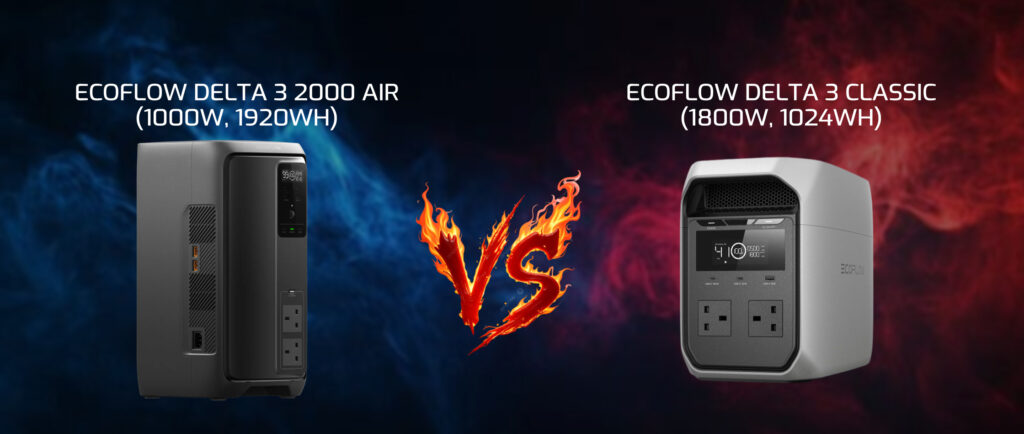
If you’re looking for an EcoFlow power station in Nigeria, you’ve probably come across the DELTA 3 2000 Air and the DELTA 3 Classic.
And you may be wondering:
Which one should I buy?
At first, the answer seems obvious – The DELTA 3 2000 Air has a much bigger battery, But the DELTA 3 Classic has a more powerful inverter
So which one actually makes more sense?
The answer depends on what you want to power.
That’s why, instead of simply comparing specifications, we decided to look at the two power stations from a more practical angle:
What can each one actually power, and for how long?
DELTA 3 2000 Air vs DELTA 3 Classic: What’s the difference?
Here’s the simplest way to understand the two models.
| DELTA 3 2000 Air | DELTA 3 Classic | |
| Battery capacity | 1920Wh | 1024Wh |
| Rated AC output | 1000W | 1800W |
| X-Boost | Up to 1500W | Up to 3600W |
| Battery | LiFePO₄ | LiFePO₄ |
| UPS | <10ms | 10ms |
| Weight | 17.8kg | 12.1kg |
EcoFlow DELTA 3 2000 Air has 1920Wh battery capacity and 1000W rated output, while the DELTA 3 Classic has 1024Wh battery capacity and 1800W rated output.
So there are two major differences:
DELTA 3 2000 Air → bigger battery
DELTA 3 Classic → more inverter power
And this is where the decision gets interesting.
What can the DELTA 3 2000 Air power?
The bigger battery gives the DELTA 3 2000 Air an advantage when your priority is longer runtime.
For example, if you’re trying to keep your:
- Laptop
- Router
- Starlink
- TV
- Fan
- Lights
- Phones
- Refrigerator
- Washing Machine
running during a power outage, having more stored energy can make a significant difference.
So if your thinking is:
“I don’t necessarily need to run very high-powered appliances. I just want my essential devices to stay on for longer.”
The DELTA 3 2000 Air becomes particularly interesting.
What can the DELTA 3 Classic power?
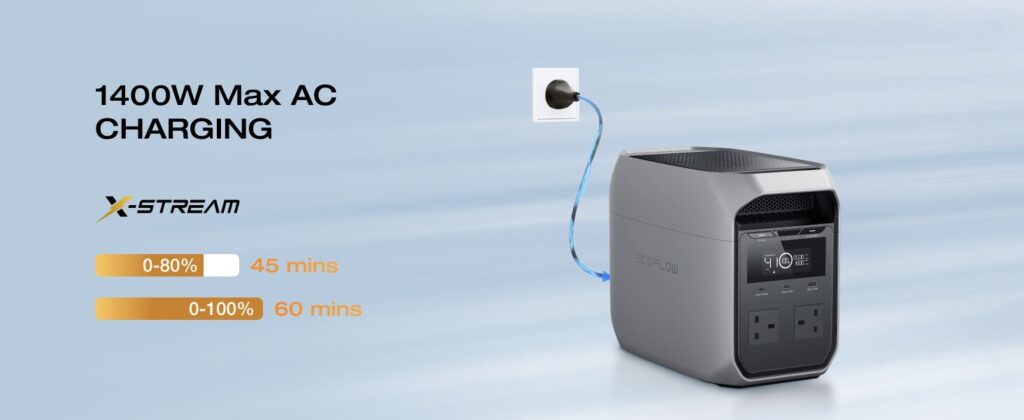
The DELTA 3 Classic takes a different approach.
It has a smaller 1024Wh battery, but its 1800W rated AC output gives it considerably more power headroom.
That matters when you’re dealing with appliances that require more power.
For example:
- Microwave
- Air fryer
- Blender
- Water pump
- Power tools
- Other higher-wattage appliances
This is why a smaller battery doesn’t automatically mean a less useful power station.
If your priority is:
“I need something that can handle higher-powered appliances.”
The DELTA 3 Classic may make more sense.
Here’s how they compare with common appliances
This is the comparison that matters most when you’re actually deciding what to buy.
| Appliance | DELTA 3 2000 Air | DELTA 3 Classic |
| Laptop (65W) | ~28 hours* | ~15 hours* |
| Fridge/Freezer (150W) | ~12 hours* | ~7+ hours* |
| 43″ LED TV (100W) | ~20 hours* | ~10 hours* |
| 0.75 HP water pump | Not recommended* | ~1 hour* |
| Air fryer (1500W) | Not recommended* | ~65–75 mins* |
| Microwave (1000W) | ~1.7 hours* | ~50 mins* |
Important: These are approximate planning estimates, not guaranteed runtimes. Actual runtime depends on the appliance’s real power consumption, inverter efficiency, startup loads, battery condition and operating conditions.
For refrigerators and freezers in particular, average consumption can differ significantly because the compressor cycles rather than drawing its rated power continuously.
Why can the DELTA 3 Classic power some appliances that the 2000 Air can’t?
This is one of the most important things to understand when buying a power station.
Battery capacity and inverter output are not the same thing.
Battery capacity is measured in Wh (watt-hours), it tells you roughly how much energy is stored in the battery.
Inverter output is measured in W (watts), it tells you how much power the power station can deliver at a given time.
So:
| Ecoflow Model | DELTA 3 2000 Air | DELTA 3 Classic |
| Inverter Capacity | 1000W | 1800W |
| Battery Capacity | 1920Wh | 1024Wh |
The 2000 Air has almost twice the stored energy, but the Classic can deliver significantly more power at once.
That’s why a bigger battery doesn’t automatically mean a power station can run every appliance.
So which one is better for your needs?
This is where we would make the decision.
Choose the DELTA 3 2000 Air if you prioritize longer backup
The DELTA 3 2000 Air makes more sense if you mainly want to run lower-to-medium power devices for longer.
Think:
Washing machine + Laptop + router + fan + TV + lights + phones
You get a larger 1920Wh battery, which gives you more energy to work with
It’s especially worth considering if you’re a: Remote worker, Student, Content creator, Home user, or small business owner who needs essential electronics to remain available during outages.
Consider the DELTA 3 Classic if you need higher power output
The DELTA 3 Classic may make more sense if you regularly need to run appliances with higher power requirements.
Think:
Microwave, air fryer, blender, water pump
Its 1800W rated output gives you more headroom for these kinds of loads. So while it can deliver more power, it won’t necessarily provide the same runtime as the DELTA 3 2000 Air.
Don’t choose based on battery capacity alone
This is probably the biggest lesson from this comparison.
Someone might see: 1920Wh vs 1024Wh and immediately assume the DELTA 3 2000 Air is the obvious choice. But then they realise they want to run a 1500W air fryer or a water pump. Now inverter output becomes much more important.
On the other hand, someone may need nothing more than a laptop, router, fan and TV during outages.
In that situation, having a larger battery can be more valuable than having a much higher inverter output.
Your appliances should determine your power station not the other way around.
How do you calculate power station runtime?
A simple starting point is:
Estimated runtime = Battery capacity (Wh) ÷ Appliance power (W)
For example, a 100W appliance connected to a 1920Wh battery gives:
1920 ÷ 100 = 19.2 hours
But real-world runtime will normally be lower because of inverter losses and other factors. That’s why the figures in our comparison are estimates rather than guarantees.
And for appliances with motors or compressors, such as refrigerators and water pumps, startup power also needs to be considered.
DELTA 3 2000 Air or DELTA 3 Classic?

There’s no universal answer.
And that’s exactly the point.
| Ecoflow Model | DELTA 3 2000 Air | DELTA 3 Classic |
| Inverter Capacity | 1000W | 1800W |
| Battery Capacity | 1920Wh | 1024Wh |
| Strength | More battery capacity → longer backup for lower-power essentials | More inverter power → more headroom for higher-powered appliances |
Still not sure which EcoFlow power station you need?
This is where we can help.
Send us:
- The appliances you want to power
- Their wattage, if you know it
- How many hours of backup you need
We’ll help you work out which EcoFlow power station or solar generator is suitable for your setup.
WhatsApp/Call: 08032170613
Shop EcoFlow Power Stations at Accenta
About this comparison
Written by Accenta Store
We help Nigerian customers choose EcoFlow power stations based on their actual power needs, rather than simply recommending the largest model.
For this comparison, we looked at the two models from the perspective of the appliances customers commonly want to run during power outages. Product specifications were checked against EcoFlow’s official Nigeria product information. Appliance runtime figures are estimates and should be treated as guidance rather than guaranteed performance.